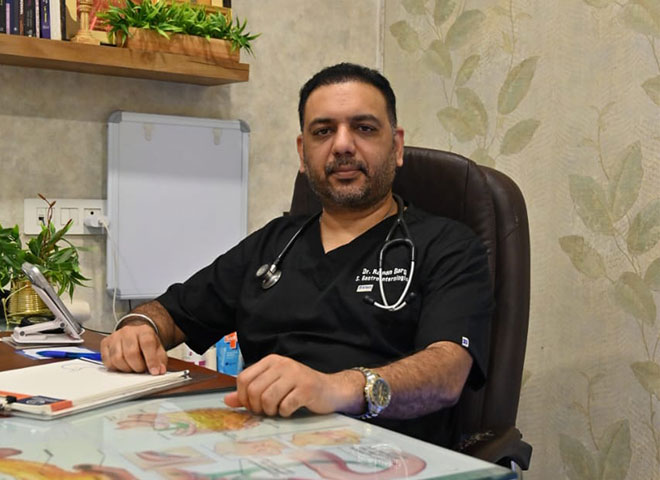
Expert fistula diagnosis and surgery by Dr. Raman Garg at BGCI Bathinda — permanent relief from chronic anal fistula.

An anal fistula (Bhagandar) is an abnormal tunnel-like channel that forms between the inner surface of the anal canal (or rectum) and the skin around the anus. It is typically the result of an unresolved perianal abscess. Anal fistulas cause persistent pain, swelling, discharge, and recurrent infections — significantly impacting quality of life.
At Bombay Gastro & Cancer Institute (BGCI) in Bathinda, Dr. Raman Garg provides comprehensive diagnosis and surgical treatment for all types of anal fistula. Using the most appropriate surgical technique for each patient's specific anatomy, he delivers excellent outcomes with the lowest possible risk of recurrence and preservation of bowel control.
The majority of anal fistulas (90%) develop from infected anal glands (cryptoglandular origin). The typical sequence is:
Fistulas are classified based on their relationship to the anal sphincter muscles (Parks Classification):
Anal fistula does NOT heal on its own. Medical treatment alone (antibiotics) can control infections temporarily but cannot cure the fistula. Surgical treatment is necessary for definitive cure. The longer you wait, the more complex the fistula can become.
Accurate mapping of the fistula tract is essential for planning effective surgery. Dr. Raman Garg uses:
The treatment strategy depends on the type and complexity of the fistula, and most importantly — whether the sphincter muscles are involved. Dr. Raman Garg's primary goal is to cure the fistula while preserving continence (bowel control).
The fistula tract is surgically opened (laid open) and allowed to heal from the inside out. This is the most effective technique with cure rates of 95%+ for simple fistulas, but is only appropriate when minimal sphincter muscle is involved. Dr. Raman Garg carefully assesses sphincter involvement before proceeding.
A flexible thread (seton) is placed through the fistula tract. Two uses:
A sphincter-preserving technique where the fistula tract is identified in the intersphincteric space, tied off, and the tract curetted. Excellent results for transsphincteric fistulas with cure rates of 60–90% and zero continence risk.
A flap of healthy rectal mucosa is advanced over the internal opening of the fistula. Used for high fistulas where sphincter preservation is critical.
Biological materials are injected into or used to seal the fistula tract. Lower cure rates (50–70%) but completely sphincter-preserving; used when other techniques are risky.
A novel endoscopic technique where a small camera is inserted into the fistula tract under direct vision, the tract is cleaned, and the internal opening is closed — all without cutting the sphincter. Excellent sphincter preservation with reasonable cure rates.
Unfortunately, a true anal fistula cannot be permanently cured without surgery. Antibiotics can control infections temporarily, but the fistula tract will persist and continue causing recurrent episodes of pain, swelling, and discharge. Surgical treatment by Dr. Raman Garg provides the only definitive cure.
Simple fistulotomy wounds typically heal within 4–6 weeks. Complex fistulas treated with sphincter-preserving techniques may take 6–12 weeks for complete healing. Regular wound dressing and follow-up with Dr. Raman Garg are important during the healing period.
This is a key concern in fistula surgery. For simple (low) fistulas, fistulotomy is performed safely with minimal continence risk. For complex (high) fistulas involving significant sphincter muscle, Dr. Raman Garg uses sphincter-preserving techniques (LIFT, advancement flap, VAAFT) to protect your continence.
Recurrence rates vary with fistula complexity and surgical technique: simple fistulotomy has less than 5% recurrence; complex fistulas have 10–20% recurrence depending on the technique used. Following all post-operative instructions and attending follow-ups with Dr. Raman Garg minimizes this risk.