Laparoscopic Ovarian Cyst Removal in Bathinda — Expert Surgery by Dr. Raman Garg
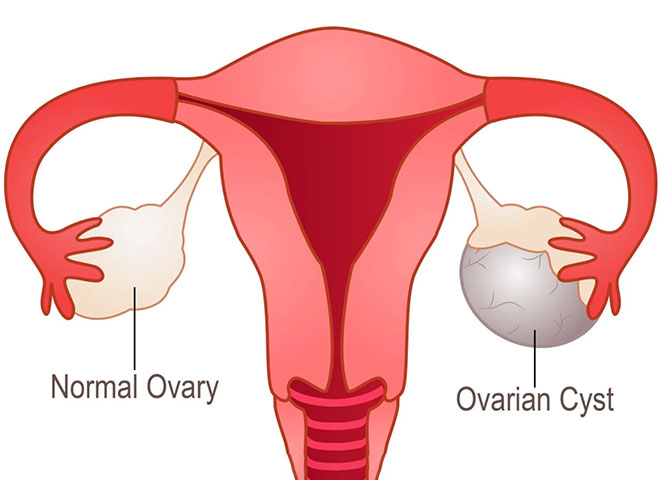
An ovarian cyst is a fluid-filled sac that develops on or within one of the ovaries. While many ovarian cysts are benign (non-cancerous) and resolve on their own, some require surgical removal due to their size, symptoms, or potential for complications.
At Bombay Gastro & Cancer Institute (BGCI) in Bathinda, Dr. Raman Garg performs laparoscopic ovarian cystectomy — a minimally invasive surgical technique that removes the cyst while carefully preserving healthy ovarian tissue and fertility whenever possible. This advanced keyhole approach means faster recovery, minimal pain, and excellent cosmetic outcomes.
Types of Ovarian Cysts
Functional Cysts (Most Common — Usually Resolve on Own)
- Follicular Cysts — Develop when a follicle doesn't release an egg; typically resolve within 1–3 menstrual cycles
- Corpus Luteum Cysts — Form after egg release; usually disappear within weeks; can occasionally become large and painful
Pathological Cysts (Require Evaluation & Often Surgery)
- Dermoid Cysts (Teratomas) — Contain tissue like hair, teeth, fat; rarely malignant; usually require surgical removal
- Endometriomas (Chocolate Cysts) — Blood-filled cysts from endometriosis; cause pain and affect fertility
- Cystadenomas — Serous or mucinous; can grow very large; require removal
- Polycystic Ovaries (PCOS) — Multiple small cysts in both ovaries; managed medically primarily
- Malignant Ovarian Tumors — Require comprehensive oncological management (see Dr. Manjit Jaura, Oncologist)
Symptoms of Ovarian Cysts
Asymptomatic (Often)
Many ovarian cysts cause no symptoms and are discovered incidentally during routine pelvic ultrasound or examination.
When Symptoms Occur
- Pelvic or lower abdominal pain — dull ache or pressure; worse with periods or intercourse
- Feeling of fullness, bloating, or swelling in the abdomen
- Irregular menstrual periods — heavier, lighter, or more painful than usual
- Difficulty emptying the bowel or bladder (large cysts compress these)
- Nausea and vomiting
- Pain during or after sexual intercourse
- Difficulty becoming pregnant (particularly endometriomas)
Emergency — Ovarian Torsion / Cyst Rupture
Sudden, severe one-sided pelvic pain — especially with nausea, vomiting, and fever — may indicate ovarian torsion (twisted ovary) or cyst rupture. This is a surgical emergency. Call +91 82641-60001 immediately or go to the nearest emergency room.
Diagnosis of Ovarian Cysts at BGCI Bathinda
- Pelvic Ultrasound — First-line imaging; characterizes the cyst (simple vs. complex, size, features)
- MRI Pelvis — For complex/suspicious cysts; better characterization of solid components
- Blood Tests — CA-125 (ovarian cancer marker), AFP, LDH, HCG for germ cell tumors; hormonal profile for PCOS
- Laparoscopy — Both diagnostic and therapeutic — can visually assess and simultaneously remove the cyst
When is Surgery Recommended?
Not all ovarian cysts require surgery. Dr. Raman Garg recommends surgical removal when:
- Cyst is large (>5–6 cm) and not resolving with observation
- Cyst has concerning features on ultrasound — solid components, thick walls, internal papillations
- CA-125 is significantly elevated in postmenopausal women
- Dermoid cyst or cystadenoma — don't resolve spontaneously
- Endometrioma — symptomatic or affecting fertility
- Ovarian torsion or cyst rupture — emergency surgery needed
- Cyst persists through multiple menstrual cycles without shrinking
- Persistent symptoms despite conservative management
Laparoscopic Ovarian Cystectomy — The Procedure
Key Principles of Dr. Raman Garg's Approach
- Ovary preservation — The healthy ovarian tissue is carefully preserved; only the cyst is removed (cystectomy), not the entire ovary, whenever safely possible
- Fertility preservation — Especially important for younger women — techniques minimize impact on ovarian reserve
- Spillage prevention — Cyst contents are aspirated before removal to prevent intra-abdominal spillage (especially for dermoids — chemical peritonitis risk)
- Histopathology — All removed cysts are sent for microscopic examination to rule out malignancy
Surgical Steps
- General anesthesia; patient positioned in Trendelenburg position
- 3 small laparoscopic incisions (5–10 mm)
- Complete pelvic assessment — uterus, both ovaries, fallopian tubes, peritoneum
- Ovary containing the cyst grasped and stabilized
- Incision made in the ovarian cortex overlying the cyst
- Cyst wall carefully dissected away from normal ovarian tissue
- Cyst aspirated and removed intact in a retrieval bag through one of the incisions
- Ovarian bed inspected for bleeding and closed with sutures or diathermy
- Operating time: 45–90 minutes
Recovery
- Hospital stay: 1–2 days
- Return to light activities: 3–5 days
- Return to work: 1–2 weeks
- Return to sports/physical activity: 3–4 weeks
- Sexual intercourse: after 3–4 weeks, when comfortable
Endometrioma (Chocolate Cyst) — Special Considerations
Endometriomas require careful surgical technique as they adhere to the ovary and surrounding structures (broad ligament, bowel). The key challenges are:
- Minimizing damage to healthy ovarian tissue — crucial for fertility preservation
- Complete excision of the cyst wall — reduces recurrence rates
- Associated endometriosis outside the ovary must also be addressed
- Post-operative medical therapy (GnRH agonists, OCP) to prevent recurrence
Why Choose Dr. Raman Garg for Ovarian Cyst Removal in Bathinda?
- Advanced laparoscopic technique — precise cyst removal preserving maximum ovarian tissue
- Fertility-conscious approach for women of reproductive age
- Experience with complex cases — endometriomas, large dermoids, bilateral cysts
- Intraoperative frozen section available for suspicious lesions
- Compassionate, personalized care for women at all stages of life
- Excellent results — serving women across south Punjab
Ovarian Cyst FAQ
01
Do all ovarian cysts need to be removed?
No. Functional cysts (follicular and corpus luteum) often resolve on their own within 1–3 months. These are managed with ultrasound monitoring. Surgery is recommended when the cyst is large (>5 cm), persistent, symptomatic, has suspicious features, or is a dermoid/endometrioma that won't resolve. Dr. Raman Garg evaluates each case individually.
02
Will removing an ovarian cyst affect my fertility?
Laparoscopic cystectomy with careful ovarian-sparing technique has minimal impact on fertility in most cases. In fact, removing endometriomas and other cysts often IMPROVES fertility. Dr. Raman Garg uses meticulous technique to preserve as much healthy ovarian tissue as possible, especially in younger women.
03
Can ovarian cysts come back after surgery?
Recurrence depends on the cyst type. Simple cysts and dermoids rarely recur after complete excision. Endometriomas have a recurrence rate of 10–15% per year without post-surgical medical treatment — which is why Dr. Raman Garg recommends appropriate hormonal therapy after endometrioma surgery.
04
How do I know if my ovarian cyst needs urgent attention?
Seek immediate medical attention if you have sudden, severe one-sided pelvic/abdominal pain — especially with nausea, vomiting, or fever. This may indicate ovarian torsion or cyst rupture — both surgical emergencies. Call +91 82641-60001 immediately.