Laparoscopic Inguinal Hernia Surgery in Bathinda — Expert Hernia Repair by Dr. Raman Garg
An inguinal hernia occurs when tissue — usually part of the intestine or abdominal fat — protrudes through a weak spot in the lower abdominal muscles or inguinal canal (the passage in the groin area). It is the most common type of hernia, accounting for approximately 75% of all abdominal hernias. Inguinal hernias are significantly more common in men due to natural anatomical vulnerabilities in the inguinal canal.
At Bombay Gastro & Cancer Institute (BGCI) in Bathinda, Dr. Raman Garg performs state-of-the-art laparoscopic inguinal hernia repair using the most advanced minimally invasive techniques — delivering excellent outcomes with minimal pain, tiny scars, and the fastest possible recovery.
Understanding Inguinal Hernia
What is the Inguinal Canal?
The inguinal canal is a passage in the lower abdominal wall through which the spermatic cord passes in men and the round ligament passes in women. This area is naturally a point of weakness in the abdominal wall. When the muscles in this area are weak or under excessive strain, abdominal contents can push through, creating a hernia.
Types of Inguinal Hernia
- Indirect Inguinal Hernia — Most common type; follows the path of the inguinal canal; can extend into the scrotum; often congenital (present from birth)
- Direct Inguinal Hernia — Pushes directly through the posterior wall of the inguinal canal; more common in older men; associated with muscle weakness from aging
- Femoral Hernia — Occurs just below the inguinal ligament; more common in women; higher risk of strangulation
Symptoms of Inguinal Hernia
- Visible bulge in the groin area — especially prominent when standing, coughing, or straining
- Aching or burning sensation at the hernia site
- Dragging discomfort or heaviness in the groin
- Pain that worsens with physical activity, bending, or coughing
- In men: swelling or discomfort in the scrotum if hernia extends there
- In infants: crying during bowel movements or when the hernia bulge appears
Emergency: Strangulated Hernia
If the hernia bulge suddenly becomes hard, tender, cannot be pushed back, and is accompanied by severe pain, nausea, or vomiting — this indicates a strangulated hernia (blood supply cut off). This is a surgical emergency. Call +91 82641-60001 immediately or go to the nearest emergency room.
Causes & Risk Factors
- Congenital weakness of the abdominal wall (present from birth)
- Age-related weakening of abdominal muscles
- Heavy lifting or strenuous physical activity
- Chronic coughing (smokers, COPD patients)
- Chronic constipation and straining during bowel movements
- Obesity — increases intra-abdominal pressure
- Pregnancy
- Previous abdominal or inguinal surgery
- Family history of inguinal hernia
Why Surgery is Required
Unlike some other conditions, inguinal hernias do not heal on their own. In fact, without treatment, they tend to enlarge over time and can lead to serious complications including:
- Incarceration — Hernia gets stuck and cannot be pushed back, causing obstruction
- Strangulation — Blood supply to the herniated tissue is cut off (life-threatening emergency)
- Bowel Obstruction — If intestine is trapped in the hernia
- Increasing pain and inability to work or perform daily activities
Therefore, surgical repair is the only definitive treatment for inguinal hernia. The good news is that with Dr. Raman Garg's laparoscopic technique, it is a safe, effective procedure with an excellent prognosis.
Laparoscopic vs. Open Inguinal Hernia Repair
Dr. Raman Garg strongly advocates for and performs the laparoscopic (keyhole) approach for most inguinal hernia repairs. The two main laparoscopic techniques are:
- TEP (Totally Extraperitoneal) — Most preferred technique; hernia is repaired without entering the peritoneal (abdominal) cavity; lower complication risk
- TAPP (Transabdominal Preperitoneal) — Repair performed through the peritoneal cavity; preferred for complex or recurrent hernias
Both laparoscopic techniques involve placing a synthetic mesh over the hernia defect from inside, which provides strong reinforcement and dramatically reduces recurrence rates compared to tissue repair.
Advantages of Laparoscopic Hernia Repair over Open Surgery:
- 3 tiny incisions (5–10mm) vs. one large groin incision
- Significantly less post-operative pain
- Return to work within 1–2 weeks (vs. 4–6 weeks for open surgery)
- Earlier return to physical activity and sports
- Lower rates of chronic groin pain (a significant complication of open repair)
- Better for bilateral (both-sided) hernias — both sides repaired through same incisions simultaneously
- Better visualization — HD camera magnifies the anatomy for precise repair
- Recurrence rates: comparable to open repair with mesh (1–3%)
The Laparoscopic Hernia Surgery Procedure at BGCI
Before Surgery
- Comprehensive pre-operative evaluation: blood tests, ECG, chest X-ray
- Anesthesia consultation (general anesthesia used)
- Fasting from midnight before surgery
- Detailed discussion with Dr. Raman Garg about the procedure and expectations
During Surgery (45–60 minutes)
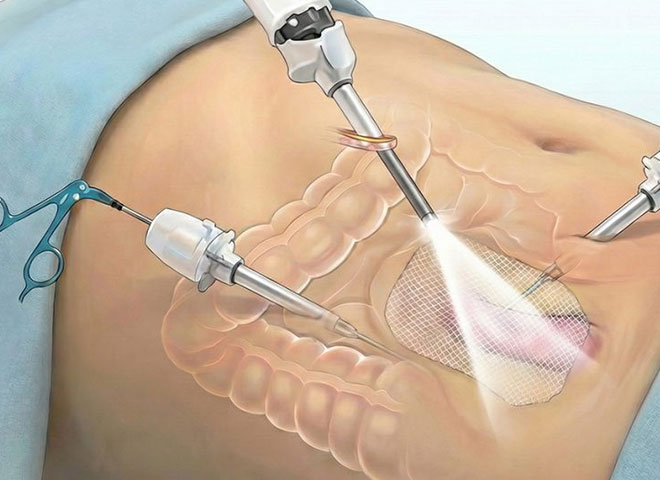
- 3 small incisions made in the lower abdomen
- Laparoscope and specialized instruments inserted
- Hernia sac carefully dissected and reduced
- Synthetic polypropylene mesh placed over the hernia defect
- Mesh secured with clips or fibrin glue
- Incisions closed with absorbable sutures
After Surgery
- Same-day discharge or overnight stay (1 day) in most cases
- Mild discomfort managed with oral pain medication
- Walking encouraged from day 1
- Light activities from day 3–5
- Return to desk job: within 1 week
- Return to physical/manual work: 2–4 weeks
- Full activity including sports: 4–6 weeks
- Follow-up at 1 week and 1 month with Dr. Raman Garg
Long-term Results & Recurrence Prevention
With proper laparoscopic mesh repair, hernia recurrence rates are very low (1–3%). Following Dr. Garg's post-operative guidelines significantly reduces this further:
- Gradual return to activity as guided
- Weight management to reduce abdominal pressure
- Avoid chronic constipation — high-fibre diet and adequate hydration
- Treat chronic cough if present
- Avoid heavy lifting beyond recommended limits long-term
Can Inguinal Hernia Affect Children?
Yes. Inguinal hernias are common in infants and children — particularly in premature babies. The recommended treatment is surgical repair, typically performed laparoscopically at BGCI under safe pediatric anesthesia. Untreated hernias in children carry a higher risk of incarceration and strangulation than in adults.
Why Choose Dr. Raman Garg for Hernia Surgery in Bathinda?
- Hundreds of successful laparoscopic hernia repairs performed
- Expertise in both TEP and TAPP techniques for optimal outcomes
- Experience with complex, bilateral, and recurrent hernias
- FMAS certified — highest qualification in minimal access surgery
- Minimal post-operative pain — most patients need just paracetamol
- Same-day or next-day discharge in most cases
- Comprehensive pre and post-operative care
Hernia Surgery FAQ
01
How do I know if I have an inguinal hernia?
The most common sign is a visible or palpable lump/bulge in the groin area that may appear when standing, coughing, or straining. It may be associated with aching or a dragging sensation. An inguinal hernia can be confirmed by physical examination by Dr. Raman Garg and ultrasound if needed.
02
Can hernia be treated without surgery?
Hernia cannot be permanently cured without surgery. Conservative management (trusses/supports) can temporarily contain the hernia but do not repair the underlying defect and carry risks of complications. Elective laparoscopic repair is safer than emergency surgery for a complicated hernia.
03
How long will I be off work after hernia surgery?
With laparoscopic hernia repair, patients with desk jobs return to work within 1 week. Those with manual/physical jobs can return after 2–4 weeks. Dr. Raman Garg provides personalized guidance based on your specific job requirements.
04
Is there a risk of hernia coming back after surgery?
Recurrence rates with laparoscopic mesh repair are very low — 1–3%. Following Dr. Garg's post-operative instructions and maintaining a healthy weight further reduces this risk. Open non-mesh repair has significantly higher recurrence rates of 10–15%.
05
Can both sides be repaired in the same operation?
Yes! This is one of the major advantages of laparoscopic surgery. Both left and right inguinal hernias can be repaired simultaneously through the same 3 small incisions, under a single anesthesia. This is not possible with open surgery without two separate incisions.