Model Town Phase 2, Bathinda
Bombay Gastro
Home About Us Our Doctors Gallery Blog Contact Us Book Appointment

Emergency Contact

+91 82641-60001 +91 99885-03800
Laparoscopic Surgery

Laparoscopic Appendix Removal in Bathinda

Emergency and elective laparoscopic appendectomy by Dr. Raman Garg at BGCI Bathinda — safe, precise, with rapid recovery.
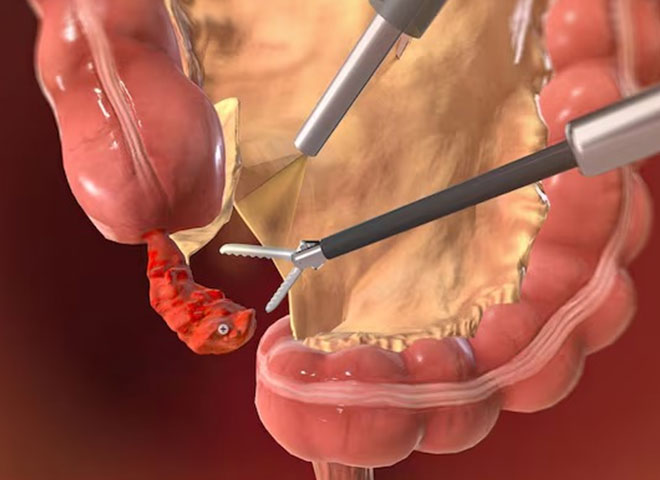
Laparoscopic Appendix Removal Bathinda

Laparoscopic Appendix Removal in Bathinda — Expert Appendectomy by Dr. Raman Garg

Appendicitis — inflammation of the appendix — is one of the most common surgical emergencies in India. The appendix is a small, finger-shaped pouch attached to the large intestine in the lower right abdomen. When it becomes inflamed (usually due to blockage), it causes severe abdominal pain that can escalate to perforation if not treated promptly.

At Bombay Gastro & Cancer Institute (BGCI) in Bathinda, Dr. Raman Garg performs both emergency and elective laparoscopic appendectomy (appendix removal) with exceptional skill and efficiency. The minimally invasive laparoscopic approach offers significant advantages over open surgery — smaller incisions, less pain, and a dramatically faster recovery.

Understanding the Appendix & Appendicitis

What is the Appendix?

The appendix is a small, finger-like pouch attached to the cecum (the beginning of the large intestine) in the lower right quadrant of the abdomen. Its exact function in adults remains debated — it may have a role in immune function early in life, but its removal has no known negative impact on health or digestion.

How Does Appendicitis Develop?

Appendicitis usually develops when the appendix becomes blocked — by hardened feces (fecalith), mucus, parasites, or in rare cases, a tumor. This blockage causes the appendix to swell and become infected. Without treatment, the appendix can rupture (perforate), spreading infection throughout the abdomen — a potentially life-threatening condition called peritonitis.

Symptoms of Appendicitis — How to Recognize It

Classic symptoms of appendicitis progress over 12–24 hours:

  • Pain — Initially around the navel (periumbilical pain), then migrates to the lower right abdomen (McBurney's point). This migration is highly characteristic of appendicitis.
  • Fever — Low-grade initially (37.5–38.5°C), can become high with perforation
  • Nausea and vomiting — Usually follows pain onset
  • Loss of appetite — Nearly universal
  • Rebound tenderness — Pain worsens when pressure is released from the abdomen
  • Diarrhea or constipation
  • Inability to pass gas

Appendicitis is an Emergency

If you or a family member has sudden severe lower right abdominal pain with nausea and fever — do not wait. Come to BGCI Bathinda immediately or call +91 82641-60001. A perforated appendix can be life-threatening. Never take laxatives or pain killers to "wait it out."

Atypical Appendicitis Presentations

In some patients, the clinical presentation can vary:

  • In pregnant women — The appendix shifts position; pain may be higher (mid/upper abdomen or right flank) — requires high suspicion
  • In elderly patients — Symptoms may be milder and less localized; perforation can occur with minimal initial signs
  • In infants and young children — Diagnosis can be challenging; vomiting and irritability may be the only signs initially
  • Retrocecal appendix — Appendix positioned behind the cecum; right flank or back pain rather than anterior abdominal pain

Diagnosis of Appendicitis at BGCI Bathinda

Dr. Raman Garg employs a systematic diagnostic approach:

  • Clinical Examination — McBurney's point tenderness, Rovsing's sign, Psoas sign, Rebound tenderness
  • Blood Tests — Complete blood count (elevated WBC), CRP (C-reactive protein) — both typically elevated in appendicitis
  • Ultrasound Abdomen — First-line imaging; can identify inflamed appendix in most cases
  • CT Scan Abdomen/Pelvis — Highest accuracy (95–98%); used when ultrasound is inconclusive; identifies perforation, abscess
  • Alvarado/MANTRELS Score — Clinical scoring system to guide decision-making

Laparoscopic Appendectomy — The Procedure

Laparoscopic vs. Open Appendectomy

Dr. Raman Garg performs laparoscopic appendectomy as the standard approach for virtually all cases of appendicitis at BGCI Bathinda. The advantages are substantial:

  • 3 tiny incisions (5–10 mm) vs. one 5–8 cm incision in open surgery
  • Excellent visualization of the entire abdomen — crucial for perforated or atypical cases
  • Lower wound infection rates (particularly important in perforated appendicitis)
  • Less post-operative pain and shorter hospital stay
  • Earlier return to normal activities (1–2 weeks vs. 4–6 weeks)
  • Better cosmetic outcome

Surgical Steps

  • General anesthesia is administered
  • 3 small incisions made (one at umbilicus, two in lower abdomen)
  • Laparoscope and instruments inserted
  • Appendix identified, dissected, and isolated
  • Mesoappendix ligated, appendix base secured with endoloops/stapler
  • Inflamed appendix removed through one of the incisions
  • Abdominal cavity irrigated if perforated
  • Incisions closed with absorbable sutures
  • Total operating time: 30–60 minutes (longer for perforated/complicated cases)

Recovery After Laparoscopic Appendectomy

Uncomplicated (Non-Perforated) Appendicitis

  • Hospital stay: 24–48 hours
  • Eating: Clear liquids same day; normal diet within 24–48 hours
  • Return to light activities: 3–5 days
  • Return to work/school: 1 week
  • Return to sports/physical work: 2–4 weeks

Complicated (Perforated) Appendicitis

  • Hospital stay: 3–7 days (IV antibiotics needed)
  • Recovery time: 2–4 weeks for full activity
  • Follow-up coloscopy recommended 6 weeks later to rule out other pathology

Can Appendicitis Be Treated Without Surgery?

Recent studies suggest that uncomplicated appendicitis (without perforation or abscess) can sometimes be managed initially with antibiotics alone. However, recurrence rates are significant (around 25–30% within 1 year), and surgery may still be needed. For most patients in Indian settings, laparoscopic appendectomy remains the gold standard definitive treatment. Dr. Raman Garg discusses the options individually with each patient.

Living Without an Appendix

Appendix removal has no known long-term health consequences. You can eat a normal diet, participate in all physical activities, and live completely normally after full recovery. The digestive system functions identically without the appendix.

Why Choose Dr. Raman Garg for Appendix Removal in Bathinda?

  • Emergency availability for appendicitis
  • Expert laparoscopic technique — thousands of procedures performed
  • Handles complex cases — perforated appendix, peritonitis, appendicular mass
  • Excellent post-operative outcomes
  • BGCI equipped for emergency surgical cases
  • Transparent communication and family counseling

Appendix Surgery FAQ

01

How quickly does appendicitis need surgery?

Appendicitis is a surgical emergency. Once diagnosed, surgery should be performed as soon as possible — ideally within 6–12 hours of diagnosis for uncomplicated cases. Delaying surgery significantly increases the risk of perforation, which greatly complicates treatment and recovery.

02

Is laparoscopic appendix removal safe for children?

Yes, laparoscopic appendectomy is safe and preferred for children. It offers the same advantages — smaller incisions, faster recovery, lower infection risk — and children generally recover very quickly from laparoscopic surgery. Dr. Raman Garg has experience with pediatric laparoscopic appendectomy.

03

What are the risks of laparoscopic appendectomy?

Laparoscopic appendectomy is a very safe procedure. Possible complications include wound infection (much lower with laparoscopy than open surgery), bleeding, injury to nearby structures (very rare), and hernia at the port site (rare). Dr. Raman Garg's extensive experience minimizes these risks significantly.

04

Can the appendix grow back after removal?

No, the appendix cannot grow back after it is completely removed. Appendectomy is a permanent procedure. Occasionally, appendix remnant stump appendicitis can occur if a small stump is left, but this is prevented with proper surgical technique.