Laparoscopic Ventral Hernia Surgery in Bathinda — Expert Hernia Repair by Dr. Raman Garg
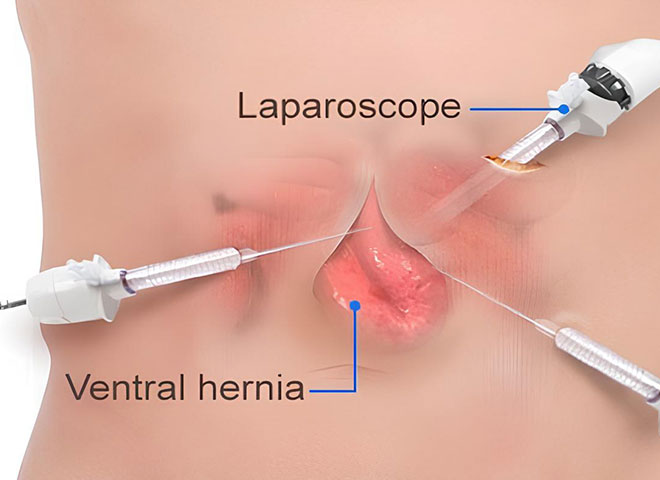
A ventral hernia is a protrusion of abdominal contents through a weakness or defect in the front (ventral) abdominal wall. Ventral hernias include umbilical hernias (at the navel), epigastric hernias (above the navel), and incisional hernias (at previous surgical scars). They can range from small, asymptomatic defects to large, symptomatic hernias causing significant discomfort and risk of complications.
At Bombay Gastro & Cancer Institute (BGCI) in Bathinda, Dr. Raman Garg performs state-of-the-art laparoscopic ventral hernia repair using the IPOM (Intraperitoneal Onlay Mesh) technique — providing strong, lasting repair with minimal surgical trauma and excellent long-term outcomes.
Types of Ventral Hernias
- Umbilical Hernia — Hernia at the navel; common in adults with obesity, multiple pregnancies, or ascites
- Para-umbilical Hernia — Just above or below the umbilicus; common in middle-aged obese adults
- Epigastric Hernia — Between the navel and lower breastbone (xiphoid process); usually small fat-containing hernias
- Incisional Hernia — Most common ventral hernia; occurs at previous surgical incision sites; affects 10–15% of patients after open abdominal surgery
- Spigelian Hernia — Rare; occurs along the spigelian fascia on the lateral abdominal wall
Causes & Risk Factors
- Previous abdominal surgery — incisional hernia
- Obesity — excess weight weakens abdominal wall
- Multiple pregnancies — stretching of abdominal muscles
- Chronic cough — repeated increased intra-abdominal pressure
- Chronic constipation and straining
- Heavy physical work
- Malnutrition and poor wound healing (post-operative)
- Wound infection after previous surgery
- Steroids and immunosuppressive medications
Symptoms
- Visible or palpable bulge in the abdomen — usually more prominent when standing, coughing, or straining
- Aching or sharp pain at the hernia site
- Dragging sensation in the abdomen
- Discomfort with physical activity or lifting
- Skin redness or excoriation over large hernias
- Inability to reduce the bulge (incarceration) — urgent surgical attention needed
- Severe pain, nausea, vomiting — strangulation emergency
Laparoscopic vs. Open Ventral Hernia Repair
For most ventral hernias, Dr. Raman Garg strongly prefers the laparoscopic IPOM (Intraperitoneal Onlay Mesh) technique:
- No large incision through potentially scarred tissue (especially important for incisional hernias)
- Comprehensive view of entire abdominal wall — detects all defects (Swiss cheese hernias)
- Mesh placed intraperitoneally (inside) providing stronger coverage of the defect
- Significantly lower wound infection rates — crucial for incisional hernias with compromised skin
- Much lower rate of seroma (fluid collection)
- Earlier recovery and return to normal activities
The IPOM Laparoscopic Procedure
- 3–4 small incisions made away from the hernia defect
- Adhesiolysis (separation of adhesions from previous surgery) using careful laparoscopic dissection
- All hernia defects identified and their dimensions measured
- Composite mesh (dual-layer — prevents bowel adhesions) placed over the defects from inside
- Mesh fixed with transfascial sutures and tacks for secure anchorage
- Operating time: 60–120 minutes (depending on hernia size and adhesions)
Recovery Timeline
- Hospital stay: 1–3 days
- Light activities: from day 2–3
- Desk work: within 1 week
- Physical/manual work: 4–6 weeks
- Abdominal binder worn for 4–6 weeks
- Avoid heavy lifting >5 kg for 6 weeks
Incisional Hernia — Special Considerations
Incisional hernias after previous abdominal surgery are the most technically demanding type to repair due to adhesions and scar tissue. Dr. Raman Garg is experienced in handling complex incisional hernias, including:
- Large (giant) incisional hernias requiring component separation
- Recurrent hernias after previous failed repairs
- Multiple defects (Swiss cheese hernias)
- Hernias with compromised skin or obesity
Why Choose Dr. Raman Garg for Ventral Hernia Surgery in Bathinda?
- Expertise in laparoscopic IPOM technique for all ventral hernias
- Experience with complex incisional and recurrent hernias
- Uses high-quality composite mesh for durable repair
- Careful adhesiolysis without bowel injury — advanced laparoscopic skills
- Comprehensive pre-surgical planning
- Excellent post-operative results with low recurrence rates (<5%)