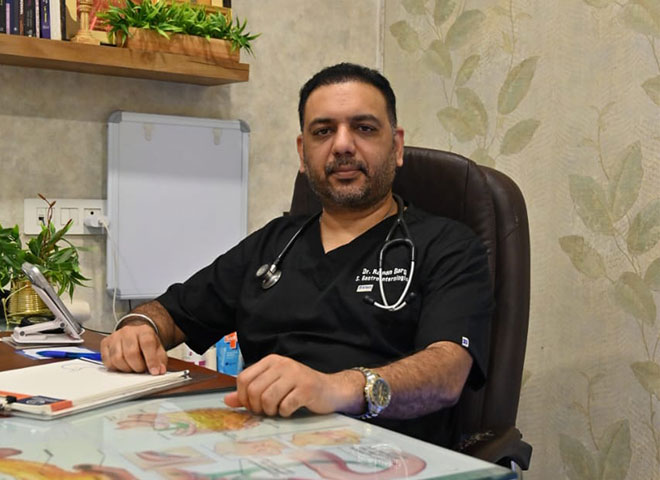
Laparoscopic Achalasia Cardia Surgery in Bathinda — Expert Heller Myotomy by Dr. Raman Garg
Achalasia cardia is a rare but significantly disabling disorder of the esophagus (food pipe) in which the lower esophageal sphincter (LES) — the muscular valve between the esophagus and stomach — fails to relax properly during swallowing. This, combined with the loss of normal peristalsis (the wave-like muscle contractions that propel food down the esophagus), makes swallowing progressively more difficult and distressing.
At Bombay Gastro & Cancer Institute (BGCI) in Bathinda, Dr. Raman Garg performs the gold-standard surgical treatment for achalasia — laparoscopic Heller myotomy — which provides the best long-term relief from swallowing difficulties with minimal patient discomfort and quick recovery.
Understanding Achalasia Cardia
What Goes Wrong in Achalasia?
In a normal person, as food is swallowed, the esophagus contracts in a coordinated peristaltic wave to propel food towards the stomach. Simultaneously, the LES relaxes to allow food to enter the stomach, then closes again. In achalasia:
- The LES fails to relax — remaining tightly contracted even during swallowing
- Peristalsis in the esophageal body is absent or abnormal
- Result: food and liquids accumulate in the esophagus, which progressively dilates
The underlying cause is degeneration of the nerve cells (Auerbach's myenteric plexus) controlling esophageal muscle function. The exact trigger remains unclear, but autoimmune and viral causes have been proposed.
Symptoms of Achalasia Cardia
- Dysphagia (Difficulty Swallowing) — Initially for solids, later for liquids too; the hallmark symptom
- Regurgitation — Undigested food and secretions returning to the mouth; especially at night (nocturnal regurgitation)
- Chest pain — Intermittent, non-cardiac chest pain from esophageal spasm
- Weight loss — Due to fear of eating and poor nutrition from ineffective swallowing
- Aspiration — Regurgitated material entering the airway; causing cough, aspiration pneumonia
- Heartburn — Despite no acid reflux; from fermentation of retained food
- Hiccups — Due to LES dysfunction
Types of Achalasia (Chicago Classification)
- Type I (Classic) — No peristalsis; minimal esophageal pressurization; responds well to myotomy
- Type II — No peristalsis but with paneosophageal pressurization; best response to all treatments
- Type III (Spastic) — Premature or spastic contractions; most challenging to treat
Diagnosis of Achalasia at BGCI Bathinda
- Barium Swallow — Classic "bird's beak" or "rat's tail" appearance at the LES with dilated esophagus above
- Upper GI Endoscopy — Excludes malignancy; shows dilated esophagus with retained food; resistance at GEJ; cardia doesn't open to air insufflation
- High-Resolution Esophageal Manometry (HRM) — Gold standard for diagnosis; identifies absent peristalsis and impaired LES relaxation; classifies achalasia type
- CT Scan Chest/Abdomen — Rules out secondary causes (pseudoachalasia from external tumors)
Treatment Options for Achalasia
1. Laparoscopic Heller Myotomy (BEST LONG-TERM OPTION)
This is Dr. Raman Garg's preferred treatment for achalasia. The procedure involves:
- 5 small laparoscopic incisions
- Surgical cutting of the muscular fibers of the LES (myotomy) — 6–8 cm on the esophagus and 2–3 cm on the stomach
- The inner mucosa is preserved, bulging through the cut — relieving the obstruction
- A partial fundoplication (Dor — anterior, or Toupet — posterior) is added to prevent post-operative GERD
Results: 85–95% success rate with symptom improvement lasting 10–15+ years. Best long-term outcomes of any achalasia treatment.
2. Pneumatic Dilation
A large balloon (30–40 mm) is passed endoscopically and forcibly dilated at the LES level, disrupting the sphincter fibers. Success rate 60–85%; may require repeat sessions; perforation risk ~2%.
3. Peroral Endoscopic Myotomy (POEM)
An advanced endoscopic procedure where myotomy is performed through a tunnel created in the esophageal wall. Excellent results comparable to Heller myotomy but higher post-POEM GERD rates.
4. Botulinum Toxin Injection
Botox injected into the LES temporarily relaxes it. Effect lasts only 6–12 months; repeat injections needed; reserved for elderly/high-surgical-risk patients.
Recovery After Laparoscopic Heller Myotomy
- Hospital stay: 2–3 days
- Liquid diet for first 1–2 weeks; soft diet weeks 2–4; normal diet by week 6
- Return to work: 1–2 weeks (desk job); 3–4 weeks (manual work)
- Long-term follow-up with esophageal manometry and endoscopy
- Most patients eat and swallow normally within weeks
Why Choose Dr. Raman Garg for Achalasia Surgery in Bathinda?
- Experience with laparoscopic Heller myotomy — technically demanding procedure requiring advanced laparoscopic skills
- Accurate diagnostic evaluation including manometry for proper achalasia typing
- Combined with appropriate fundoplication to prevent GERD
- Detailed follow-up to monitor swallowing outcomes and detect recurrence
- No need to travel to major cities — advanced achalasia care in Bathinda